Subterranean termite control in Western Massachusetts requires a calibrated approach adapted to cold-climate soil dynamics. In the South River Valley and along the wet loam borders near Gould Hollow, seasonal snowmelt…
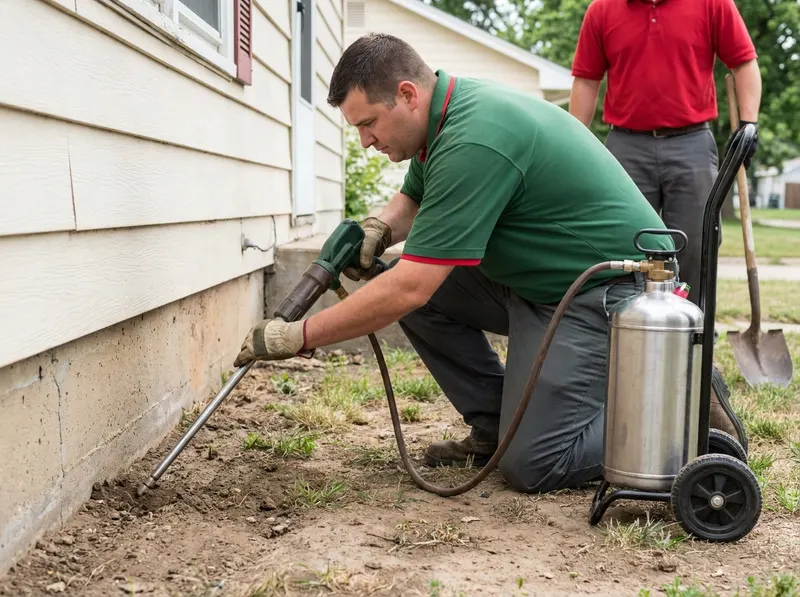
Subterranean termite control in Western Massachusetts requires a calibrated approach adapted to cold-climate soil dynamics. In the South River Valley and along the wet loam borders near Gould Hollow, seasonal snowmelt and elevated water tables force colonies to nest below the frost line, typically 36 to 48 inches deep, before foraging upward into sill plates and floor joists during spring warming cycles. Properties situated along the Ashfield Plain Border and the rocky slopes of the Pomeroy Mountain Vicinity often feature historic fieldstone foundations, where termites exploit deteriorating lime mortar joints as sheltered entry conduits. Liquid barrier applications require precision trenching down 6 inches into structural perimeter soil, utilizing non-repellent formulations that foraging workers unknowingly transport back to the central subterranean queen.
Property owners evaluating intervention options face distinct operational tradeoffs between liquid chemical barriers and slow-acting cellulose bait matrices. Continuous liquid termiticide treatments provide immediate, localized mortality zones around structural perimeters, delivering immediate containment for active framing compromises; however, fieldstone foundations with fractured mortar, common across the Kansas District and North Poland Road Area, can demand complex masonry drilling to establish a contiguous zone. Hexaflumuron or noviflumuron bait systems eliminate the necessity of drilling interior concrete slabs and reduce overall chemical volume near private water supplies, though bait consumption and total colony collapse typically require 60 to 180 days of active station monitoring. Standard interior air quality remains uncompromised because modern non-repellent termiticides feature near-zero vapor pressure and bond directly to organic soil compounds rather than off-gassing into interior basements.
A definitive diagnosis differentiates subterranean termites from carpenter ants (Camponotus pennsylvanicus) and wood-boring powderpost beetles. Subterranean termites require continuous ambient moisture and maintain structural contact with sub-surface earth via earthen mud tubes composed of chewed wood, soil, and biological secretions. Carpenter ants do not consume wood tissue, excavating smooth, polished nesting galleries and leaving visible coarse sawdust frass, whereas subterranean termites consume the soft springwood layers, leaving a characteristic hollowed, layered lattice packed with dried clay residues. Liquid interventions address soil-based worker vectors, whereas carpenter ant protocols target dry wood framing voids. Technicians operating throughout Franklin County hold state regulatory pesticide credentials and confirm on-site soil depth, private well setbacks, and proximity to sensitive agricultural zones like Bear Swamp Orchard or South River drainage systems before termiticide application commences.
Every job gets a firm, written price after a free on-site visit.
Tell us about your subterranean termite treatment job in Kansas and we'll send a clear, written quote, usually the same day.
 Viresta Insect Experts