Powderpost beetle infestations in western Massachusetts routinely affect properties containing antique timber, rough-sawn dimensional lumber, and high-humidity crawlspaces. True powderpost beetles (Lyctinae) target…
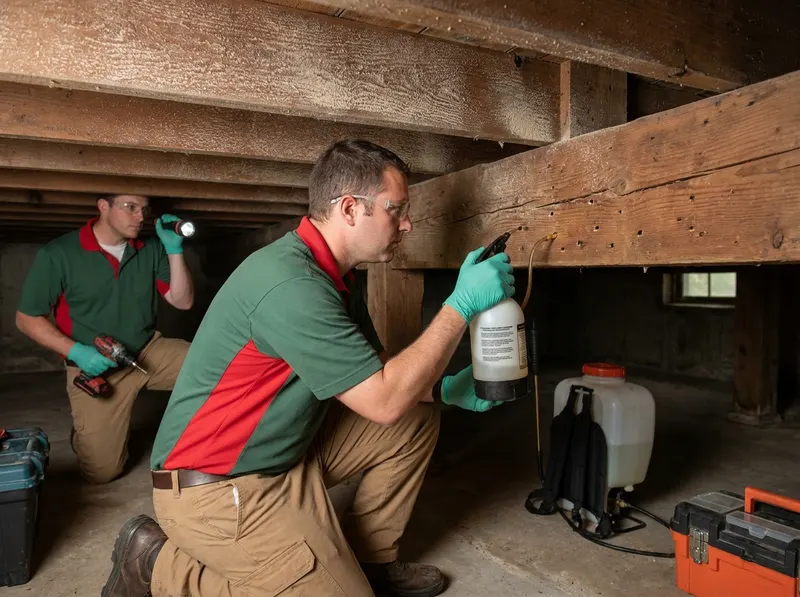
Powderpost beetle infestations in western Massachusetts routinely affect properties containing antique timber, rough-sawn dimensional lumber, and high-humidity crawlspaces. True powderpost beetles (Lyctinae) target large-pore hardwoods such as oak and ash with starch content above 3 percent, while deathwatch beetles (Anobiidae) consistently degrade softwood framing when structural moisture levels exceed 14 percent. In the South River Valley and around the North Poland Road Area, unconditioned basements and earthen crawlspaces frequently absorb seasonal humidity from South River State Forest runoff, elevating wood moisture and creating conditions for re-infestation. Remediation prioritizes systemic, deep-penetrating disodium octaborate tetrahydrate (DOT) solutions applied directly to bare wood rather than non-selective atmospheric fumigation. This borate chemistry bonds with the cellulose matrix, neutralizing wood-ingesting larvae upon feeding while preventing off-gassing into indoor air living spaces.
Decision-fit guidance depends on the accessibility of the framing and current moisture content. If structural timber exhibits visible, unsealed surfaces with fresh, flour-like frass powder falling from 1/16-inch pinholes, topical chemical penetration remains the most targeted and cost-effective approach. Conversely, where framing members are fully enclosed behind finished plaster, tongue-and-groove boards, or vapor barriers, common in renovated farmsteads near Pomeroy Mountain Vicinity and Ashfield Plain Border, selective panel removal or localized cavity injection is required. A localized application resolves active galleries without broad-spectrum chemical dispersion, but it requires that unsealed structural surfaces be cleared of dirt, mold, or existing paint films to permit liquid borate penetration of at least 1/4 inch into the timber depth.
Remediation sequencing follows three technical steps: 1. Pinpoint diagnostic mapping using digital pin-type moisture meters to isolate timbers holding over 12 percent moisture content. 2. Mechanical surface preparation to vacuum exit holes and expose raw wood grain along sills, rim joists, and floor supports. 3. Low-pressure chemical saturation with an inorganic borate formulation, followed by drying monitoring. Addressing ambient crawlspace humidity through ground vapor barriers or supplemental dehumidification is required concurrently; without moisture stabilization below 12 percent, wood remains structurally susceptible to re-infestation by secondary anobiid species regardless of chemical intervention.
Every job gets a firm, written price after a free on-site visit.
Tell us about your powderpost beetle remediation job in Kansas and we'll send a clear, written quote, usually the same day.
 Viresta Insect Experts