Carpenter ant elimination requires distinguishing wood-nesting ants from subterranean termites to execute an effective protocol. In the forested landscape of Franklin County, mature colonies establish parent nests in…
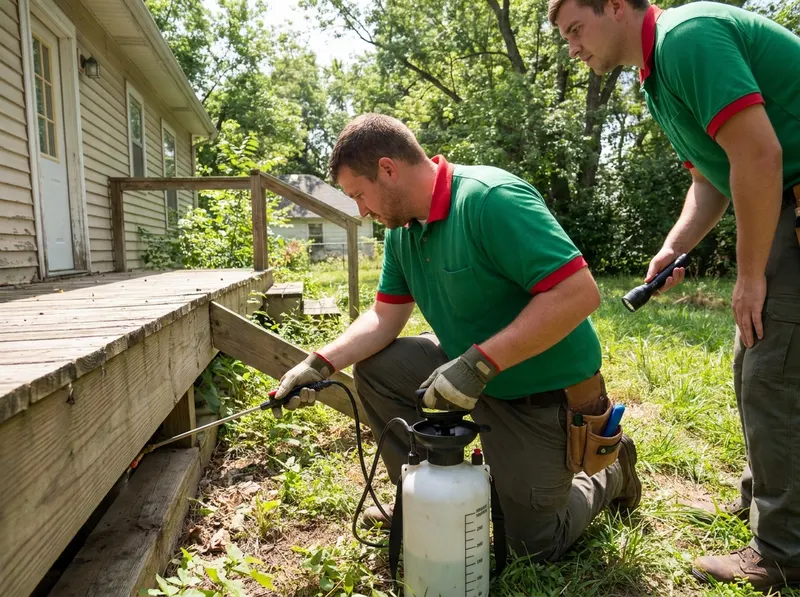
Carpenter ant elimination requires distinguishing wood-nesting ants from subterranean termites to execute an effective protocol. In the forested landscape of Franklin County, mature colonies establish parent nests in damp tree cavities near South River State Forest or Pomeroy Mountain before excavating indoor galleries. Unlike termites, carpenter ants do not digest cellulose; they hollow out smooth galleries inside structural framing, sills, and window headers, depositing wood shavings known as frass outside small kick-out holes. Over-the-counter repellent pyrethroid sprays cause colonies to fragment into multiple satellite nests within wall voids, multiplying the infestation points. Targeted intervention relies on non-repellent liquid formulations and microencapsulated baits that foragers carry directly into the central queen chamber without detection.
Residential homes located along Gould Hollow and South River Valley frequently experience pressure from ambient moisture generated by dense shade and riparian humidity. When moisture exceeds 20 percent inside structural sill plates or roof eaves along North Poland Road, wood softens sufficiently for satellite colonies to expand rapidly. Proper eradication couples exterior root-collar and perimeter soil barriers with precision wall void injections. This method protects internal air quality and local private well-water tables, avoiding indiscriminate broadcast chemical applications inside living areas while severing the foraging pathways running from Bear Swamp Orchard tree lines directly into siding.
Properties in the Ashfield Plain Border and Pomeroy Mountain Vicinity face distinct seasonal pressures during early spring emergence. Winged reproductive swarmers inside the home indicate a mature parent or secondary colony that has occupied the framing for at least two to three seasons. Choosing professional colony eradication over repeated seasonal trapping eliminates the underlying queen rather than merely pruning visible worker trails. The service protocol follows three clear phases: 1. Acoustic and thermal detection of wall voids to locate active galleries. 2. Direct void injection with biological transfer agents and exterior band treatment. 3. Mechanical trimming recommendations for overhanging foliage to prevent structural re-entry.
Every job gets a firm, written price after a free on-site visit.
Tell us about your carpenter ant elimination job in Kansas and we'll send a clear, written quote, usually the same day.
 Viresta Insect Experts