Stinging insect populations in Franklin County peak between mid-summer and early autumn when colony sizes reach 1,000 to 5,000 workers. In rural parcels along the South River Valley and Gould Hollow, yellowjackets…
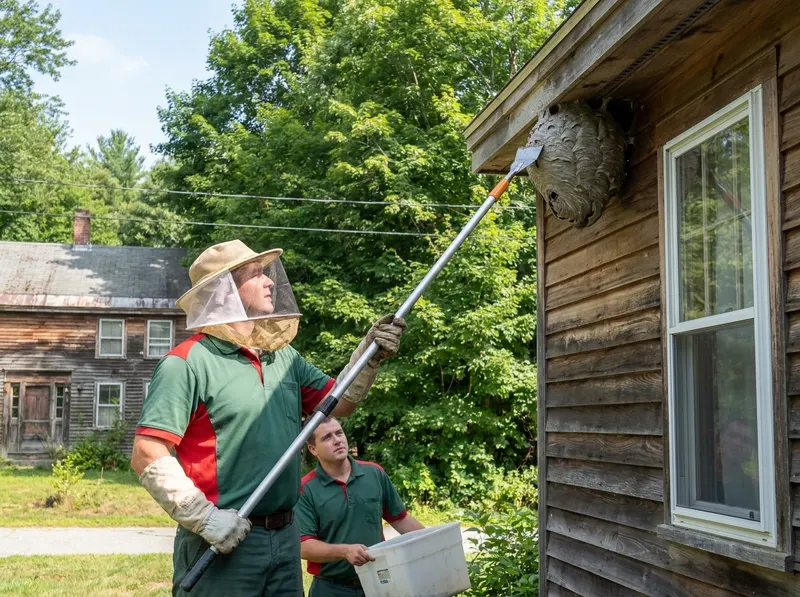
Stinging insect populations in Franklin County peak between mid-summer and early autumn when colony sizes reach 1,000 to 5,000 workers. In rural parcels along the South River Valley and Gould Hollow, yellowjackets establish subterranean nests inside abandoned rodent burrows, while bald-faced hornets construct large paper cartons high in hardwoods bordering South River State Forest. Structural nesting frequently occurs in the Kansas District and North Poland Road Area, where paper wasps exploit attic soffits, dormer returns, and exterior rake boards. Left unmanaged, these colonies expand inward, using wood-pulp enzymes that degrade drywall and allow insects to breach bedroom or living spaces.
Targeted professional eradication is distinct from retail pesticide applications. Over-the-counter pyrethroid sprays trigger an alarm pheromone release that causes aerial dispersal and aggressive counter-stings, often failing to reach the central brood chamber or the laying queen. A clinical approach utilizes micro-fine active dusts injected under pressure directly into void openings, coating returning foragers and transferring throughout the nest matrix without saturating surrounding soils or drifting toward private wellheads near the Ashfield Plain Border or Highland Springs Reservoir. For aerial nests in the Pomeroy Mountain Vicinity, technicians execute complete physical removals using protective containment shrouds, preventing toxic residue on building siding and stopping scavenger birds from distributing residual comb material.
Property owners face a distinct trade-off when selecting structural nest treatment versus preventative perimeter sealing. Knocking down an active exterior nest neutralizes the current biological threat in 1 to 3 hours, but does not prevent secondary queens from scouting the same fascia boards the following spring. Long-term defense requires a secondary mechanical exclusion, screening louvers with 1/8-inch wire mesh, sealing trim gaps with elastomeric caulk, and treating micro-cavities. This systematic approach preserves indoor air quality, protects regional pollinator flight corridors away from structures, and eliminates the recurring expense of repeated emergency callouts.
Every job gets a firm, written price after a free on-site visit.
Tell us about your stinging insect nest removal job in Kansas and we'll send a clear, written quote, usually the same day.
 Viresta Insect Experts