Basement spider and centipede mitigation stabilizes the lowest levels of rural homes where elevated relative humidity and fieldstone foundations create prime harborages. In properties situated throughout the South…
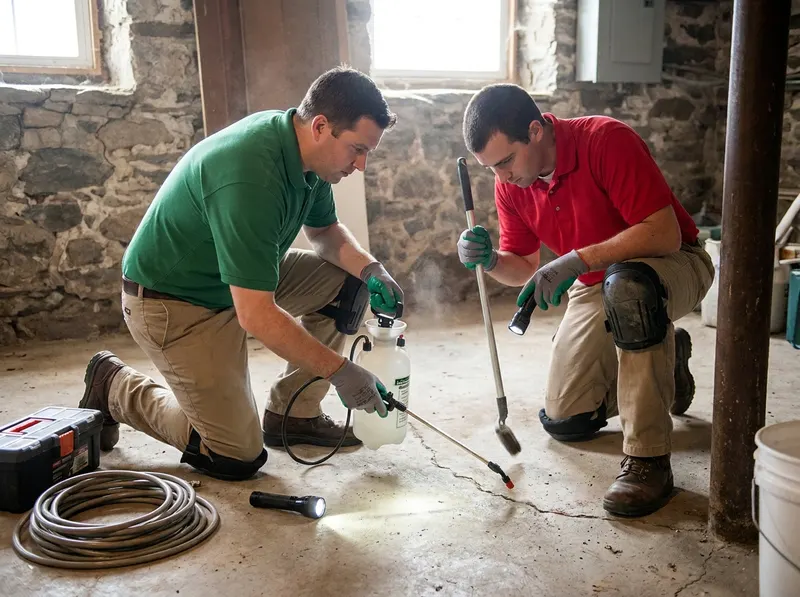
Basement spider and centipede mitigation stabilizes the lowest levels of rural homes where elevated relative humidity and fieldstone foundations create prime harborages. In properties situated throughout the South River Valley and along the Ashfield Plain Border, subterranean dampness allows house centipedes and wolf spiders to flourish by feeding on silverfish, sowbugs, and fungus gnats. Centipedes require high ambient moisture to maintain internal hydration, meaning their presence indicates an underlying humidity elevation or active prey population beneath the living quarters. A singular aerosol application provides only temporary cosmetic knockdown, whereas a structural approach seals micro-fissures along sill plates, installs targeted desiccating dusts inside wall voids, and applies a low-volatility barrier along interior masonry perimeters.
Homes in the Pomeroy Mountain Vicinity and Gould Hollow often feature stone masonry or aging poured concrete that expands and contracts across freeze-thaw cycles. Field specialists identify entry pathways near sub-grade utility lines, sump pits, and walk-out thresholds. For dry, finished basements experiencing isolated cellar spider activity, mechanical removal and exterior foundation exclusion are typically sufficient. Conversely, unfinished rubblestone basements near the Kansas District or North Poland Road Area require comprehensive void treatments coupled with dehumidification guidance to lower ambient relative humidity below 50 percent, which eliminates the fungal and prey-insect baseline that sustains predatory populations.
The process follows four distinct operational stages: 1. Complete visual inspection of basement perimeters, sill plates, and sub-slab plumbing penetrations. 2. Mechanical web removal and targeted vacuuming of egg sacs and adult specimens. 3. Precision application of EPA-registered, low-odor microencapsulated formulations or amorphous silica dust directly into structural cracks, keeping treatments away from domestic water lines and private wells. 4. Exterior foundation perimeter defense spanning 2 to 3 vertical feet up the masonry to intercept crawling arthropods migrating inward from adjacent forest floors.
Every job gets a firm, written price after a free on-site visit.
Tell us about your basement spider and centipede mitigation job in Kansas and we'll send a clear, written quote, usually the same day.
 Viresta Insect Experts