Commensal rodent exclusion establishes an impenetrable physical boundary between urban rodent populations and interior building envelopes. In Kansas, older housing stock across Hyde Park, Coleman Highlands, and…
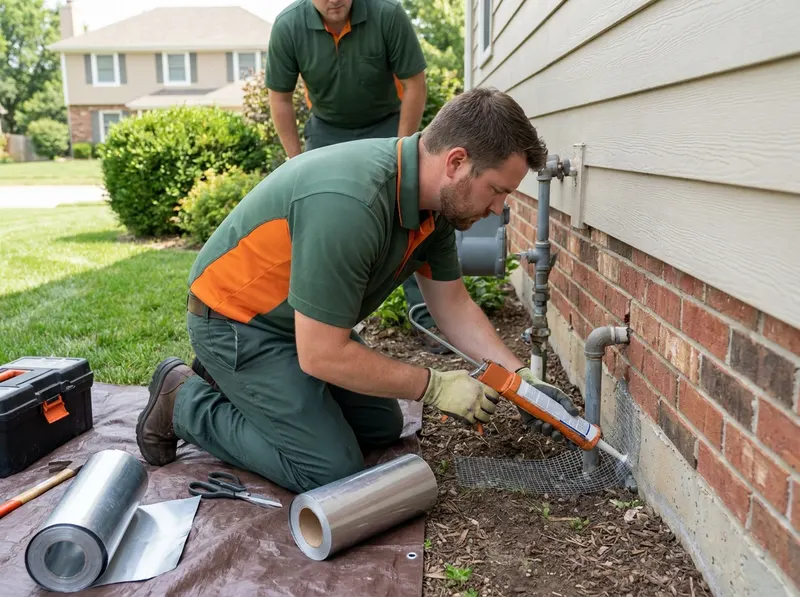
Commensal rodent exclusion establishes an impenetrable physical boundary between urban rodent populations and interior building envelopes. In Kansas, older housing stock across Hyde Park, Coleman Highlands, and Pendleton Heights frequently presents rubble stone foundations, settling sills, and aged mortar joints that offer micro-pathways for foraging rodents. A juvenile house mouse requires an aperture of merely one-quarter inch (6.35 mm) to gain interior access, while an adult Norway rat can penetrate a gap measuring one-half inch (12.7 mm). Chemical broadcast baiting alone fails to solve re-infestation dynamics because it addresses transient symptoms rather than structural vulnerability; non-chemical physical exclusion resolves the foundational vulnerability permanently without introducing indiscriminate rodenticides into living spaces where domestic pets dwell.
Commercial and mixed-use structures in the Crossroads Arts District and River Market experience elevated pressure due to high-density subterranean utilities and food-waste generation. For properties built upon slab foundations, such as retail parcels in the Country Club Plaza or residential bungalows in Brookside and Waldo, exclusion focuses heavily on garage door astragals, weep holes, crawlspace vents, and utility conduit penetrations. Technicians mechanically fasten corrosion-resistant 19-gauge or 16-gauge galvanized wire hardware cloth across crawlspace vents and chimney caps, while packing utility entries with industrial copper mesh and anchoring them with elastomeric, polyurethane sealants. Standard expanding aerosol foams are omitted entirely, as rodents chew through low-density polyurethane polymers within hours.
Property owners facing active rodent activity must distinguish between temporary interior trapping and permanent exterior exclusion. Trapping eliminates existing interior vectors but leaves exterior conduits open, ensuring secondary colonies relocate into the structure within weeks. Physical exclusion requires greater initial labor and diagnostic effort, but eliminates the continuous expense of recurring chemical bait replenishment. Diagnostic assessments evaluate exterior rooflines, soffits, and foundational masonry to produce a clear architectural map of all ingress zones prior to physical sealing.
Every job gets a firm, written price after a free on-site visit.
Tell us about your commensal rodent exclusion job in Kansas and we'll send a clear, written quote, usually the same day.
 Viresta Insect Experts